
Holy Saturday in the Shadow of Empire
The Christ My Body Knows, Part Six

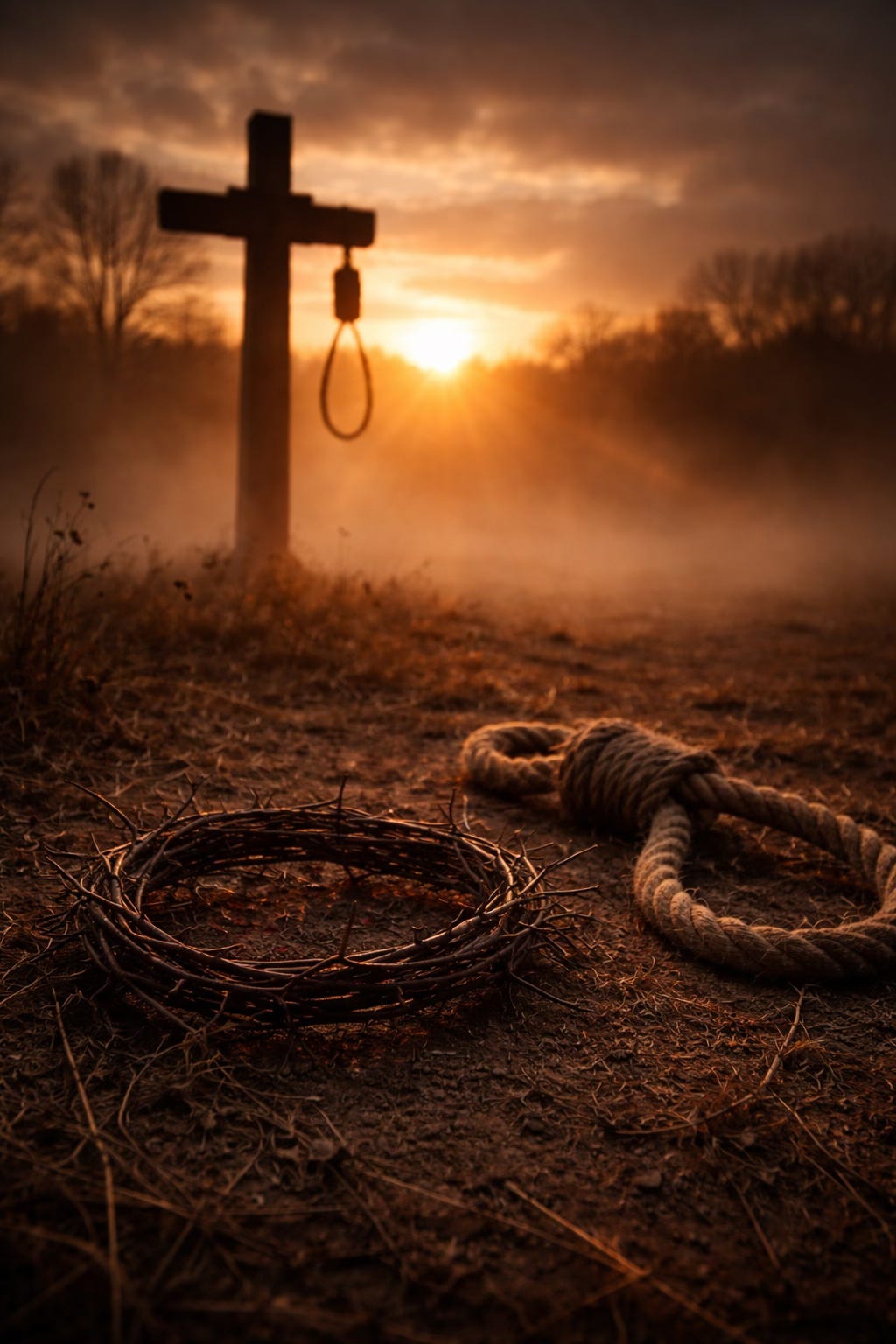
What does resurrection mean when the system remains intact?
There is a silence that follows spectacle.
A silence empire depends on.
Over these weeks we have moved from recognition, to occupation, to interpretation, to spectacle.
Now we ask what resurrection means in a world still shaped by empire.
The rope leaves a long shadow.
So does a cross.
We have spent these weeks naming what many of us were trained not to name.
Two Jesuses.
A colonized Christ.
A curated Bible.
A lynched body.
We have followed Jesus from synagogue to surveillance, from proclamation to spectacle.
And now we arrive at the silence.
Holy Saturday.
The day after empire makes its point.
When Empire Thinks It Has Won
The system, the multinational corporations supported by some of the strongest militaries in the world, especially the USA, thinks it has won by instigating coups, crushing national economies, stealing natural resources, removing leaders from power, detaining immigrants, and even shooting unarmed civilians.
Rome believed crucifixion worked.
That was the point.
Bodies were displayed so others would comply.
Shame was amplified so resistance would shrink.
Crowds were formed so violence would look like order.
Lynching functioned the same way.
It disciplined communities.
It narrowed imagination.
It trained witnesses.
Public terror requires formation.
Before a crowd gathers under a tree, it has already been catechized.
Before a cross can be called justice, Scripture has already been curated.
Empire edits.
Empire rewards.
Empire narrates.
And when the body is buried, empire expects silence.
The Afterlife of Terror
But terror does not end when the spectacle ends.
It lingers in nervous systems.
In migration patterns.
In enlistment papers signed for survival.
In fathers at sea.
In mothers praying alone at night.
In children scanning classrooms for danger they cannot yet name.
I did not have language for hypervigilance when I was young.
I only knew I was always reading the room.
Tone.
Posture.
Silence.
The rope leaves a long shadow.
Even when the textbooks do not.
Even when the courts acquit.
Even when the headlines move on.
Holy Saturday feels like that.
The violence has happened.
The body is buried.
The system remains intact.
And the question hangs:
Was empire right?
Two Jesuses in the Silence
This is where the two Jesuses diverge again.
The Jesus of civil religion says:
Move on.
Be calm.
Trust the process.
Do not make this political.
He offers resurrection without reckoning.
But the Christ my body knows does not rush the silence.
He knows what it is to be buried by the state.
He knows what it is to be declared finished.
He knows what it is to leave disciples confused and afraid.
Holy Saturday is not denial.
It is the space where grief refuses to be managed.
What Resurrection Is Not
Resurrection is not anesthesia.
It does not erase lynching.
It does not undo occupation.
It does not pretend Scripture was never weaponized.
It does not tell the traumatized to calm down.
Resurrection does not sanctify the crowd.
It does not vindicate Pilate.
It does not bless the machinery of terror.
If heaven has taken sides—as Good Friday reveals—then resurrection is not neutrality.
It is refusal.
Refusal to let empire narrate the ending.
Black Faith Already Knows This
Black faith has practiced Holy Saturday for generations.
Denied the right to read—and learning anyway.
Denied the right to vote—and organizing anyway.
Denied the right to gather—and worshiping in hush harbors anyway.
Reconstruction rose briefly from the grave—schools built, offices held, communities formed—before terror tried to crucify it again.
And still, people persisted.
The rope did not get the last word.
Not because the rope was weak.
But because hope refused to be managed.
Resurrection in Black tradition has rarely looked like triumph.
It has looked like survival.
Like migration.
Like education.
Like mutual aid.
Like spirituals sung under watch.
Like children who refuse to disappear.
Resurrection is not denial of death.
It is defiance in its presence.
Where Do We Stand Now?
If God is found in the lynched body,
if Jesus was colonized, surveilled, executed by the state,
if Scripture has been curated to protect power,
if crowds have been trained to call violence order—
then where do we stand?
Not in abstraction.
Now.
In this moment.
When war language fills headlines.
When books disappear.
When stories are shaped.
When worship can anesthetize or awaken.
Where do we stand?
Holy Saturday asks that question without spectacle.
It asks it in the quiet.
When the Headlines Change but the Pattern Remains
The forms evolve.
The pattern does not.
Masked agents detain bodies and call it enforcement.
Sanctions constrict economies and call it strategy.
Bombs fall and are framed as stability.
Political leaders are seized and described as justice.
The vocabulary is tidy.
The bodies are not.
Before any of this becomes normal, imagination must be trained.
We must be taught which suffering counts.
We must be taught which violence is regrettable but necessary.
We must be taught whose fear is legitimate—and whose is exaggerated.
The cross asks different questions.
Where is the vulnerable body?
Who benefits from the framing?
Who is being asked to absorb the cost?
The Christ my body knows is not found in the briefing room.
He is found with the detained.
With the bombed.
With the sanctioned.
With the publicly shamed.
Not because policy questions are simple.
But because crucifixion was not simple either.
And God was located in the body that power tried to erase.
The Christ My Body Knows
The Christ my body knows was lynched by the state.
Buried by empire.
Declared finished by power.
And raised without its permission.
Not to erase the scars.
But to expose them.
Resurrection does not remove the wounds.
It reveals that they did not have the final authority.
The rope leaves a long shadow.
But it does not own the sunrise.
The cross casts darkness.
But it does not command the morning.
The Christ my body knows does not rush me past the shadow.
He stands with me in it.
And from there—not from denial, not from civility, not from managed calm—
he begins something empire cannot predict.
Where Resurrection Begins
If heaven has taken sides,
if God is found in the publicly humiliated,
if resurrection belongs to the executed—
then I know where I must stand.
Not with the machinery.
Not with the crowd.
Not with the curated comfort.
But with the wounded who refuse to disappear.
That is where resurrection begins.
Your thoughts? Leave a comment.
Author’s Note:
This reflection continues a series tracing Jesus through empire, spectacle, and embodiment. It is shaped in part by the theological work of James Cone and the lived witness of Black faith traditions that have long refused to separate resurrection from history.
AMEN!
Out of the crushing darkness and suffering emerges the power of life nothing can stop.
The last will be first, the “weak” will be strong, and the intimidating tyrants of empire and those who comply will suffer the consequences of their blindness and cruelty.