
Read the Room
On Reparations, Grief, and the Politics of Selective Compassion

“Pastoral truth does not whisper when people are dying.”
I don’t yet know every legal detail. I’m not writing as an attorney or an administrator.
I’m writing as a pastor who once buried too many truths under polite language.
Reports are circulating that Columbia University is preparing to offer financial reparations or settlements of $21 million to Jewish employees harmed during pro-Palestinian protests.
Perhaps some were harmed.
That should be taken seriously.
But seriousness is not neutrality.
And repair is never innocent; it always reveals what we’re willing to remember, and what we choose to forget.
A few weeks ago, I received an email from the United States Holocaust Memorial Museum, urging donations because of a spike in antisemitism.
I replied simply:
Read the room.
Right now, we—including Jews—should be raising support for Palestinians.
I did not say that because antisemitism is imaginary.
It is not.
Antisemitism is one of the most persistent, lethal hatreds in human history. It culminated in genocide. It continues to mutate. It must always be confronted.
As a student years ago, one of the main reasons I chose my doctoral thesis topic was to examine how the anti-Judaism that predated Christianity in the Roman Empire was absorbed by the Church. I believe now more than ever that antisemitism is built into institutional Christianity.
I oppose antisemitism. I oppose Islamophobia. I oppose anti-Blackness. I oppose every form of racial and religious hatred that seeks to deny human dignity and extinguish life.
But here is the pastoral truth we avoid because it makes people uncomfortable:
Some suffering is already believed.
Some suffering still has to prove itself.
Jewish pain is real—and it is legible.
Black pain is real—and it is debated.
Palestinian pain is real—and it is criminalized.
That difference did not fall from the sky.
African Americans endured centuries of enslavement, lynching, legal apartheid, racial terror, economic theft, and carceral control.
This is not disputed history. It is documented fact.
And yet there have been no reparations.
There have been task forces.
There have been symbolic gestures.
There have been delays dressed up as prudence.
Contrast that with the speed and clarity with which institutions can now imagine repair for some forms of harm—and not others.
Because Black faculty and administrators—at Columbia and beyond—have endured decades of systemic harm: isolation, retaliatory tenure denials, public silencing, forced resignations, and relentless emotional labor in service of “diversity” they were never protected by. And that doesn’t consider how challenging it was for them to get hired in the first place.
Where is the repair for them?
Where is the public reckoning for the scholars and staff who have paid the cost of truth-telling with their careers?
When institutions choose to repair one history of harm while actively ignoring another, they are not being morally neutral.
They are revealing the politics of whose pain matters—and whose doesn’t.
This is not about envy.
It is about moral muscle memory.
Some communities do not need to kneel in order to be seen.
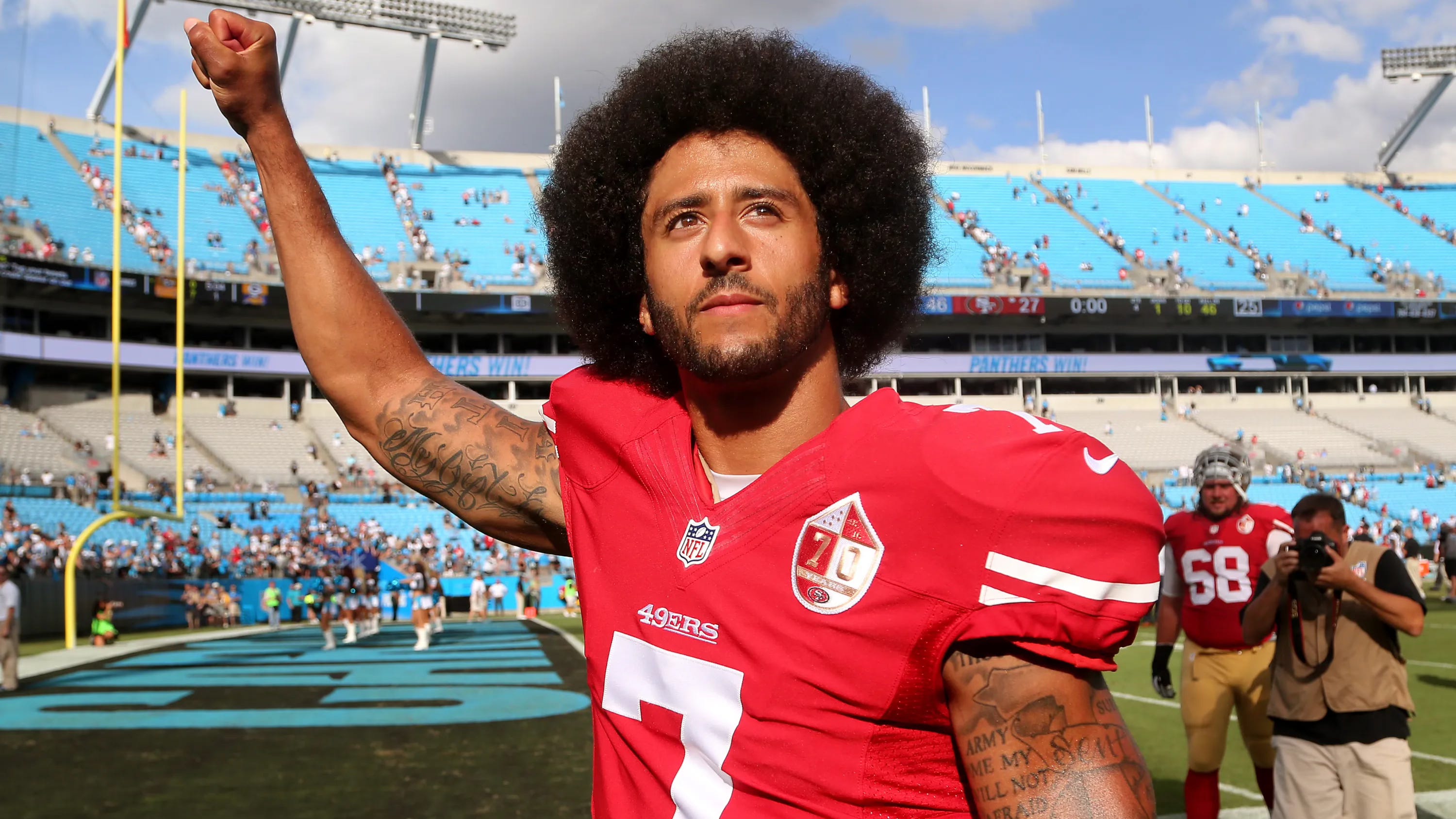
The Jewish community in the United States does not need an attention-calling figure like Colin Kaepernick, because Jewish suffering already carries historical authority.
It does not require spectacle to be taken seriously.
That is not a moral failing.
It is a social fact.
Kaepernick lost his career to make Black death visible.
Even then, the message was distorted, sanitized, and punished.
A number of white quarterbacks several years older than Kap have been pulled out of the mothballs because of so many injuries. Just ponder this. One of the teams in Sunday’s Super Bowl lost its QB in its recent Playoff game. What if his backup were an experienced, seasoned leader like Colin Kaepernick?
Visibility is not evenly distributed—even in pain.
Now place Palestinians into this landscape.
They are starved, bombed, displaced, buried under rubble—often with American weapons, American money, and American silence.
And yet their suffering is treated as suspicious, excessive, or rhetorically dangerous to name.
To speak of it publicly is to risk accusations.
To organize around it is to invite discipline.
To grieve it is to be interrogated.
This is not pastoral care.
It is moral containment.
I am not interested in competing traumas.
I am interested in truth.
Reparations offered in a world that refuses to repair its deepest wounds become a mirror of power, not justice.
When institutions rush to compensate harm that fits their moral comfort zones while postponing or denying repair for foundational violence,
they reveal what they value—and whose pain they trust.
“Never again” is a sacred phrase.
But it curdles when it becomes selective.
Never again cannot mean:
Never again for Jews, but ongoing for Palestinians.
Never again for some histories, but perpetual delay for others.
Never again as memory, but not as policy.
Pastorally speaking, this is what scripture calls unequal weights and measures.
The prophets were relentless about this.
So was Jesus.
Not because God enjoys accusation—but because God hates lies dressed up as righteousness.
So I am asking institutions, donors, universities, and faith communities to do one hard thing:
Read the room.
The room is full of grief that does not have a grant form.
The room is full of bodies that will never be compensated.
The room is full of people whose suffering has been normalized, rationalized, or postponed until a “better time.”
And if repair is real,
it must be brave enough to confront that imbalance—not sanctify it.
This is not a call to abandon Jewish safety.
It is a call to refuse a moral economy that protects some while disciplining others.
Pastoral truth does not whisper when people are dying.
It names what is happening.
It calls power to repentance.
And it insists that mercy, if it is from God, must widen—not narrow—our field of care.
These are the kinds of actions that help to explain why the Black Radical Tradition has always stood in solidarity with Palestinians.
Read the room. The room is on fire.

Right on David! 👍☝️🙏🙌
So powerful. Thank you.